.webp)
Misaligned teeth are not just a cosmetic concern; they affect how you bite, chew, speak, and clean your mouth every single day. The good news is that most cases, from mild crowding to moderate spacing issues, respond well to orthodontic treatment, especially clear aligners.
However, understanding what you are dealing with is the first step toward fixing it properly.
Clinically, misaligned teeth are described as malocclusion, which literally means "bad bite." It refers to an improper alignment of the teeth, the jaws, or both. More specifically, it involves how individual teeth are positioned within the dental arch and how the upper jaw (maxilla) and lower jaw (mandible) relate to each other when the mouth closes.
This matters more than most people realize. When the bite is off, even slightly, it changes how forces are distributed across the teeth during chewing. Some teeth absorb pressure that they were never designed to handle. Others barely make contact at all. Over time, that imbalance creates real problems: worn enamel, jaw fatigue, and in some cases, chronic discomfort in the temporomandibular joint.
Malocclusion also affects speech. Certain sounds, particularly sibilants like "s" and "z," rely on precise tongue-to-tooth contact. When the teeth are not where they should be, speech can be affected in ways that are subtle but noticeable to the speaker.
Oral hygiene suffers too. Overlapping or rotated teeth create tight spaces where a toothbrush cannot reach, and floss cannot pass cleanly. Plaque builds up, calcifies, and the risk of cavities and gingivitis increases significantly. So while many patients first notice misaligned teeth in the mirror, the clinical concern goes well beyond appearance. It is a functional pathology with downstream consequences for long-term oral health.
Malocclusion is not one single problem. It is an umbrella term that covers several distinct patterns of misalignment. Each has its own structural cause, its own effect on oral function, and its own treatment considerations.
Crowding occurs when there is not enough space in the dental arch to accommodate all the teeth. The result is that teeth overlap, rotate, or push behind one another. It is one of the most common forms of misaligned teeth and typically develops when the jaw is too narrow relative to the size of the teeth. Crowding is also a frequent consequence of premature tooth loss in childhood, where neighboring teeth drift into the empty space and leave no room for the permanent tooth to erupt correctly.
Spacing, or diastema, is essentially the opposite problem. Gaps form between teeth when the jaw is proportionally larger than the teeth it holds, or when teeth are simply smaller than average. A single gap between the two upper front teeth is one of the most recognizable presentations, but spacing can appear anywhere in the arch. Missing teeth also create spacing problems, as surrounding teeth tend to migrate toward the gap over time.
An overbite, also called a deep bite, describes a condition where the upper front teeth overlap the lower front teeth excessively in a vertical direction. Some vertical overlap is completely normal, around two to three millimeters. When it exceeds that, the lower teeth may bite into the roof of the mouth, and the lower front teeth become subject to accelerated wear. A significant overbite is often rooted in skeletal proportions rather than tooth position alone.
An underbite is the reverse situation. Here, the lower teeth extend in front of the upper teeth when the jaws close. This can stem from a lower jaw that has grown too far forward, an upper jaw that is underdeveloped, or both. Dental underbites (where only the teeth are involved) are generally more treatable with orthodontics. Skeletal underbites often require a broader treatment plan.
A crossbite occurs when one or more upper teeth sit on the inside of the lower teeth rather than the outside. It can affect the front teeth (anterior crossbite) or the back teeth (posterior crossbite). Unlike most other types of malocclusion, crossbites are considered particularly important to address early because they can shift the jaw to one side during growth and lead to facial asymmetry over time.
An open bite is characterized by a gap between the upper and lower front teeth even when the jaws are fully closed. The back teeth may make contact, but the front teeth simply do not. This pattern is frequently linked to prolonged thumb sucking, pacifier use past age three, or tongue thrusting habits. When the tongue rests against the front teeth during swallowing, it exerts constant low-grade pressure that gradually pushes them outward and upward.
Not all misaligned teeth are created equal. The same type of malocclusion can range from barely noticeable to clinically significant, and severity directly determines which treatment approach makes sense.
Mild malocclusion typically involves a discrepancy of less than three millimeters. This might look like a slightly rotated incisor, a small gap between two teeth, or a minor overbite that is just beyond the normal range. Functionally, the impact is minimal. Most people with mild misalignment chew fine and have no speech issues. These cases respond well to clear aligner therapy and often complete treatment within a shorter timeframe.
When the discrepancy falls between three and six millimeters, the case is considered moderate. Crowding becomes visually apparent. Bite irregularities start affecting chewing efficiency. Patients at this stage may notice uneven wear on their teeth or occasional jaw discomfort. Moderate cases are still within the range that clear aligners handle effectively, though treatment is more involved and typically takes longer.
Severe malocclusion involves discrepancies greater than six millimeters and often reflects underlying skeletal problems, not just tooth position. The functional and aesthetic compromise at this stage is significant. Chewing is impaired, the face may look asymmetric, and the risk of long-term joint damage is elevated. Severe cases usually require traditional braces, and some require surgical intervention to reposition the jaws before orthodontic treatment can be completed.
Severity determines the treatment pathway, which is why an accurate assessment from an orthodontist matters far more than a self-diagnosis based on appearance alone.
Misaligned teeth rarely happen randomly. There are specific biological mechanisms behind almost every case.
The size and shape of the jaw are largely inherited. If a parent has a narrow maxilla or a prominent mandible, the child is statistically more likely to develop a similar skeletal pattern. This is why malocclusion tends to run in families. Genetics sets the structural baseline, and everything else builds on top of it.
This is the primary driver of crowding. When the combined width of the teeth exceeds the available space in the arch, there is simply nowhere for all the teeth to line up straight. The jaw may be average-sized but the teeth are large, or the jaw may be narrower than typical. Either way, the result is the same: crowding, rotation, or impaction.
Habits that apply repetitive pressure to the teeth and jaws during development can significantly alter their trajectory. Thumb sucking past age five, prolonged pacifier use, and tongue thrusting all fall into this category. These habits do not cause dramatic overnight changes, but years of consistent low-level force reshape the dental arches and occlusal relationships in ways that eventually require orthodontic correction.
Chronic mouth breathing, often caused by allergies, enlarged adenoids, or a deviated septum, has a measurable effect on craniofacial development. When a child breathes through the mouth rather than the nose, the tongue drops away from the roof of the mouth and no longer provides the outward pressure needed for normal palate development. The result is a narrow, high-arched palate and a corresponding narrowing of the dental arch. This creates conditions favorable for crowding and crossbite.
Periodontal disease causes bone loss around the roots of the teeth. As the supporting bone recedes, teeth lose their anchorage and begin to drift, flare outward, or tilt. This type of tooth migration can produce spacing, rotation, or bite changes in adults who previously had straight teeth. Treating the underlying gum disease is essential before any orthodontic work can be done.
When a baby tooth is lost too early, whether from decay, trauma, or extraction, the neighboring teeth begin to drift into the vacant space. By the time the permanent tooth is ready to erupt, there may not be enough room, and it comes in rotated or impacted. Space maintainers placed immediately after early tooth loss can prevent this, but if left unaddressed, premature tooth loss becomes a reliable setup for crowding later.
The clinical consequences of untreated malocclusion extend across multiple systems. Uneven occlusal load distribution accelerates wear on certain teeth while leaving others underutilized. Overlapping areas retain plaque that brushing and flossing cannot adequately reach, raising the risk of cavities and gingivitis. Over time, abnormal bite patterns place stress on the temporomandibular joint (TMJ), potentially contributing to TMJ disorders characterized by clicking, pain, or limited jaw movement. Speech and chewing inefficiency round out a picture that is clearly more than cosmetic.
This is one of the most common questions people ask, and the honest answer is: rarely, and only within narrow limits.
In children, certain mild presentations can self-correct as the jaws grow and permanent teeth erupt. Slight spacing sometimes closes naturally as the arch develops. Habit-related misalignment, like a minor open bite caused by thumb sucking, may resolve once the habit stops before age seven or eight. Early-stage crowding in mixed dentition can improve if space is managed properly. However, these are exceptions rather than the rule, and they apply almost exclusively to growing patients.
Moving teeth requires controlled orthodontic force applied consistently over time. That force triggers a biological process called bone remodeling, where bone is gradually resorbed on the pressure side of the tooth and deposited on the tension side, allowing the tooth to shift. No natural method replicates this process with the precision or sustained force needed to make meaningful positional changes. Natural approaches can support oral health and create a more favorable environment for treatment, but they cannot independently correct malocclusion in the way orthodontics does.
While natural methods cannot fix established misaligned teeth, they can play a meaningful supporting role, especially in children during active development.
Orofacial myofunctional therapy addresses the muscle patterns that influence jaw and arch development. Exercises that retrain tongue posture, lip seal, and swallowing patterns can reduce the forces that drive certain types of malocclusion. In young children with open habits or low tongue posture, OMT can contribute to more favorable arch development, particularly when combined with early orthodontic monitoring.
Stopping thumb sucking and correcting chronic mouth breathing early removes the environmental pressure that shapes developing arches in unfavorable directions. Nasal breathing exercises and, where necessary, treatment of underlying airway issues (such as allergy management or adenoid assessment) can meaningfully reduce the risk of worsening misalignment in children.
Maintaining healthy gums and bone around the teeth prevents the periodontal disease-driven tooth migration that creates secondary misalignment in adults. Regular professional cleaning, proper brushing technique, and consistent flossing are not orthodontic treatment, but they do preserve the stability of tooth position and prevent a situation that would otherwise require correction.
Adequate calcium and vitamin D support the bone density that keeps teeth anchored in proper position. Deficiencies in these nutrients during childhood and adolescence can compromise jawbone development and reduce the structural support teeth need to maintain their alignment through growth.
Clear aligners work through the same biological mechanism as braces: controlled orthodontic force. Each aligner in the series applies approximately 0.5 to 1.5 Newtons of force to specific teeth, compressing the periodontal ligament on one side and stretching it on the other. This pressure triggers bone resorption at the leading edge and bone formation at the trailing edge, allowing the tooth to move incrementally in the intended direction. For a deeper look at the mechanism, see our guide on How Do Clear Aligners Work?.
Modern clear aligner systems handle a broad range of cases effectively. Mild to moderate crowding, spacing issues including diastema, mild overbite and underbite, minor crossbite, and relapse after previous braces treatment all fall within the reliable scope of aligner therapy. Treatment planning software allows orthodontists to map out precise tooth movements before the first aligner is even printed.
Aligners have real limitations. Severe skeletal discrepancies, complex multi-plane rotations, and significant open bite cases with skeletal involvement do not respond well to aligner therapy alone. These cases may require traditional fixed appliances (braces) or, in the most difficult situations, surgical orthodontics to reposition the jaws before orthodontic finishing can begin.
The right treatment for misaligned teeth depends on where a case falls on the severity scale. Here is how options break down across each stage.
| Severity | Discrepancy | Primary Treatment | Key Notes |
| Mild | Less than 3mm | Natural methods + clear aligners | Shorter timeline, lower complexity; early interceptive care in children can reduce future treatment needs |
| Moderate | 3 to 6mm | Clear aligners | Attachments often required for complex movements; outcomes are predictable with qualified orthodontic oversight |
| Severe | Greater than 6mm | Braces or surgical orthodontics | Orthognathic surgery may be needed to reposition the jaw; most involved in recovery, but often the only stable long-term solution |
The reasons to treat misaligned teeth extend well beyond a straighter smile. Better bite alignment reduces uneven wear and joint stress. Properly aligned teeth are substantially easier to clean, which lowers the risk of cavities and gum disease over a lifetime. Facial balance improves when the jaw and teeth are in proper proportion. And for many patients, the confidence that comes with a corrected bite is itself a meaningful quality-of-life improvement.
Each form of malocclusion has its own causes, risk factors, and correction pathway. If you suspect crowding, a deep overbite, an underbite, a crossbite, or an open bite, each condition has a dedicated guide that walks through the specifics in detail, including what drives it, how severity is assessed, and which treatment options apply.
Knowing exactly what type of misaligned teeth you are dealing with is where every effective treatment plan starts.

Curated the best for your knowledge
 Are Ultrasonic Cleaners Worth It for Clear Aligners?
Yes, ultrasonic cleaners for clear aligners can be worth it, especially for removing plaque, debris, and buildup that regular brushing may miss. They use high-frequency sound waves to create tiny bubbles that help loosen buildup from the trays and other orthodontic appliances, including retainers, mouthguards, and night guards. However, they are not essential for everyone and have some limitations. Here’s how ultrasonic cleaners work, their benefits and drawbacks, and how to use one safely.
Read More The Aligner Diet: Can Clear Aligners Really Cause Weight Loss?
Some people notice they've lost a little weight after starting clear aligner treatment. It can happen, especially during the first few weeks, when taking the trays out for every meal and snack takes some getting used to. Sore teeth can also make eating less appealing for a day or two. The amount of weight lost varies from person to person, and not everyone experiences this change. Below, we'll break down why it happens, whether it's actually good for you, and what to know before treating your aligners like a diet plan.
Read More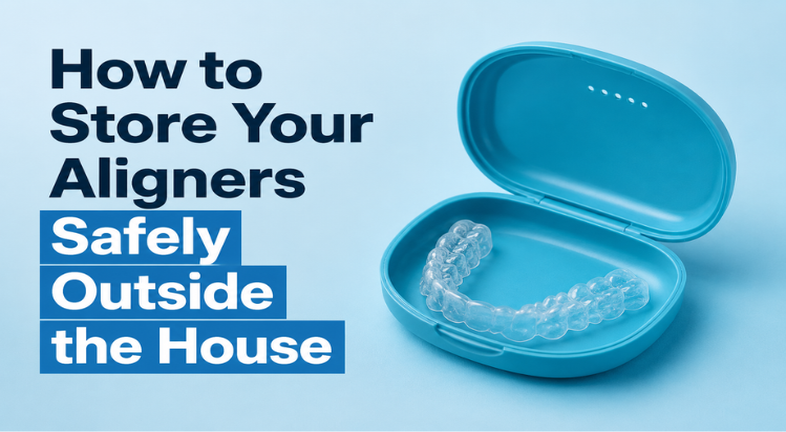 How to Store Your Aligners Safely Outside the House
Taking your clear aligners out while you're away from home is part of everyday life. The important part is knowing where to keep them until it's time to wear them again. Whether you're eating at a restaurant, traveling, running errands, or attending a social event, instead of leaving them on the table or wrapping them in a tissue or napkin, place them in a protective aligner case. Poor storage can lead to lost, damaged, or dirty aligners.
Read More



Heading