


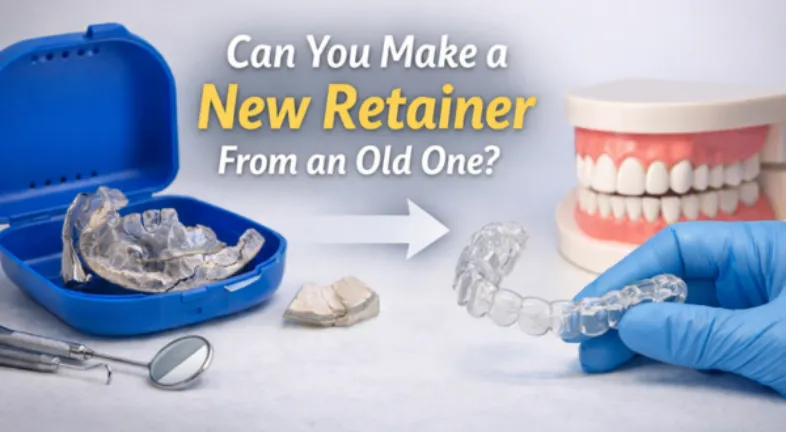
Finally, you have completed your orthodontic journey. Your braces are removed, your teeth have been straightened, and the months of wearing rubber bands, tightening, and using aligners have worked. You look in the mirror, take a deep breath, and smile; your teeth look great! But then your heart starts racing when you open your retainer case and realize it’s gone. Or even worse, your retainer is either broken, warped, or discolored.
Now, you feel as if you have no idea how to achieve that final step in retaining your perfect smile, which leads you to ask the most common question of people in your position: Can you make a new retainer from an old one? Sounds simple, right? After all, you have one already. Why not recreate it? However, it’s never as easy as that.
Why Retainers Are Not Extras
Retainers aren’t just plastic trays you wear because your orthodontist told you to. They’re the final chapter of your orthodontic journey. Braces and aligners move your teeth into position, but your teeth are naturally inclined to drift back toward their original alignment. Ligaments, muscles, and bone all play a part in this constant, quiet movement.
Even slight pressure from chewing or speaking can influence the position of your teeth over time. That’s why retention is considered a lifelong step in orthodontics. Skipping it, even occasionally, can undo months of progress. A retainer doesn’t correct your teeth again; it keeps them in place. And in many ways, it’s the unsung hero of your smile.
The Truth about Making a New Retainer from an Old One
Here’s the reality: you can’t learn how to make a retainer from an old one, at least not in any way that guarantees a proper fit. Your old retainer reflects where your teeth were at a specific point in time. Teeth aren’t static; they continue shifting subtly throughout your life.
Professional retainers are made from precise molds or digital scans, capturing every ridge, contour, and angle of your teeth. Without fresh data, no lab can recreate that fit accurately, which is why understanding what to do if your retainer doesn’t fit matters. It may feel okay at first, but it can create pressure in the wrong places, leave gaps that allow teeth to move, or cause discomfort. In some cases, it may even accelerate unwanted movement. Your old retainer is a helpful placeholder but not a replacement mold.
Why Teeth Move, Even after Orthodontic Treatment
Teeth are living structures that respond to forces around them. Ligaments stretch and compress, bone remodels, and jaw muscles constantly exert pressure. Even subtle habits, such as chewing on pens, grinding at night, or leaning on your teeth while thinking, contribute to shifts over time.
This natural movement means that even a retainer made just a year ago is slightly outdated. This is also why attempting “how to make a retainer” yourself can backfire.
Aligner Brands That Make Retainers Simple
If you’ve had clear aligners or are considering a replacement retainer, a few brands stand out for credibility and quality.
Invisalign
.webp)
Invisalign remains the most well-known provider, offering Vivera retainers, which are thicker, durable, and designed for long-term use. If you completed Invisalign treatment, your orthodontist likely has your scans on file, which makes reordering straightforward.
Caspersmile
Caspersmile is another reputable brand that offers custom retainers made from at-home impressions. They’re popular for retainers after braces or aligner treatment. The process is simple: you take an impression using the kit they send, mail it back, and receive a precision-made retainer molded to your current teeth.
Both options provide professional, medically accurate retainers. However, you may have to visit your dentist for Invisalign, but Caspersmile retainers will be sent to your home without requiring a full in-office visit.
Options for Getting a New Retainer
If your retainer is lost, broken, or no longer fits, there are several ways to replace it. You can return to your orthodontist or a local dental clinic for new impressions or scans, which ensures the highest precision. But modern orthodontics also offers convenient alternatives through trusted at-home services.
Here’s a clear comparison:
| Provider Type | Convenience | Cost Range | Time to Receive | Notes |
| Orthodontist/Invisalign | Medium | £450 to £600. | 1–3 weeks | Professional supervision, highly precise fit |
| At-home services like Caspersmile | High | £150 | 2–4 weeks | DIY impression kit or digital scan, professional lab-made retainers |
Things to keep in mind:
- Always check that your teeth haven’t shifted significantly before ordering an at-home retainer.
- Follow instructions carefully when taking impressions at home; a small error can lead to a poor fit.
- Avoid trying to reshape or heat your old retainer; it won’t produce a safe or accurate replacement.
When Your Old Retainer Still Fits
If your old retainer slips in snugly and feels comfortable, it can be used temporarily until a replacement is ready. But even a good-fitting retainer doesn’t guarantee protection indefinitely.
Plastic wears down, bacteria build up, and teeth may still be shifting minutely. Relying on an old retainer for too long can create a false sense of security. Think of it as a stopgap measure, helpful but not permanent.
What Happens if You Don’t Replace a Lost Retainer
At first, skipping a retainer seems harmless. Nothing feels different. But movement starts subtly. A tooth nudges slightly forward, another drifts back. Your bite feels different. Eventually, changes become visible in the mirror and in photos.
Minor shifts may seem insignificant, but even small changes can have a noticeable effect on your smile. Delaying a replacement can ultimately lead to more expensive correction treatments. Retainers aren’t optional; they’re preventative.
When Teeth Have Already Shifted
If your teeth have already moved and your old retainer no longer fits, forcing it in is a bad idea. A tight, ill-fitting retainer can hurt gums, crack teeth, and worsen alignment. Instead, consider minor correction programs.
Some brands, including Caspersmile and Invisalign, provide short-term correction aligners to move teeth back slightly before fitting a new retainer. Acting quickly is key: the sooner you address minor shifts, the less complex and costly the correction.
Tips for Proper Retainer Care
Even the most perfectly made retainer can fail if neglected. To extend its lifespan and effectiveness:
- Rinse it after every use.
- Brush it gently with a soft toothbrush.
- Avoid heat and direct sunlight, as they can cause the plastic to warp.
- Store it in a ventilated case to prevent bacterial buildup.
- Keep it out of reach of pets, especially dogs, who may see retainers as chew toys.
Consistent care ensures your retainer continues to protect your smile for years.
How Retainers Are Made: A Quick Look
Understanding the manufacturing process helps explain why old retainers can’t just be copied. First, a dentist or orthodontist captures the current shape of your teeth using either a digital scan or a physical mold. From this, a precise 3D model is created. Medical-grade plastic is molded over this model, trimmed, and polished.
The result is a retainer that fits snugly and distributes pressure evenly. This level of accuracy can’t be achieved by reshaping an old retainer at home. It’s a custom device designed around your exact bite, and it matters.
Your Smile Deserves Long-Term Protection
So, can you make a new retainer from an old one? Technically, no. But you can replace it easily, safely, and effectively. Modern options, whether at your orthodontist’s office or through at-home providers like Caspersmile, make it simple to get a custom retainer that protects your smile.
Every night you snap in a new retainer is a quiet victory, a small act of self-care that preserves months or years of hard work. Whether you’re asking how do I get a new retainer through an orthodontist or an at-home service, acting quickly protects your smile because your smile is worth it, and taking the right steps now keeps it exactly where it belongs.





Heading