Choosing clear aligners is no longer a simple yes-or-no decision. With so many options available, comparisons like Smile White vs Invisalign or Invisalign vs. Diamond Whites Aligners are becoming increasingly common. While they all aim to straighten teeth discreetly, they’re built for very different needs, budgets, and case complexities.
For many people, the right choice isn’t about brand popularity alone. It’s about understanding how much correction you need, how much professional oversight you want, and how predictable you expect the results to be. This guide breaks down Smile White clear aligners vs Invisalign in a practical, side-by-side way to help you make an informed decision.
Clear aligners are a broad category that refers to removable, transparent plastic trays designed to straighten teeth gradually over time. These trays are custom-made to fit your teeth and are worn for most of the day, typically 20–22 hours, depending on the treatment plan.
Clear aligners work by applying controlled pressure to specific teeth, moving them incrementally with each new set of trays. Many brands now offer this type of treatment, often focusing on convenience, affordability, and at-home or hybrid care models. These systems are commonly used for mild to moderate alignment concerns such as small gaps, light crowding, or minor cosmetic corrections.
Invisalign is an in-office, dentist-supervised brand within the clear aligner category. It operates at the premium end of the market. It’s one of the earliest and most established aligner systems and is widely used by dentists and orthodontists worldwide.
Invisalign treatment typically involves in-clinic 3D scans, a detailed digital treatment plan, and ongoing supervision by a dental professional. The system uses proprietary materials and attachments designed to improve grip, precision, and predictability, especially in more complex tooth movements or bite-related corrections.
What sets Invisalign apart:
Because of this structure, Invisalign is often recommended for moderate to complex orthodontic cases that may be difficult to treat with simpler aligner systems.
Smile White, along with similar brands, falls under the broader clear aligner category rather than being a direct equivalent to Invisalign. These aligner systems are generally designed to be more budget-friendly and streamlined, often relying on simpler treatment protocols and reduced in-person supervision.
What sets Smile White apart:
For people whose main goal is improving minor appearance and function issues rather than addressing major bite problems, Smile White or similar aligner systems like Caspersmile may be enough.
Understanding this distinction is key. The decision isn’t just about choosing between Smile White and Invisalign, but about choosing the right level of aligner treatment for your specific dental needs.
When comparing Smile White aligners vs Invisalign, several factors matter more than branding alone.
One of the biggest differences is cost. Clear aligners cost for brands like Smile White is typically much lower than Invisalign. Budget aligner systems are often designed to reduce overhead, making them appealing to cost-conscious patients.
Invisalign, on the other hand, is more expensive due to in-clinic scans, ongoing professional supervision, and advanced materials.
Smile White and similar aligner systems are generally intended for mild to moderate alignment issues. These may include slight crowding, small spacing, or minor cosmetic adjustments.
Invisalign is often better suited for moderate to complex cases, including rotations, bite issues, and more challenging tooth movements. This difference becomes critical if you’re deciding between aligners vs braces or considering Invisalign as an alternative to fixed appliances.
Invisalign uses proprietary materials designed to improve fit and control. This often leads to more predictable tooth movement, especially in complex cases.
Budget aligners like Smile White may use standard aligner plastics. While effective for simpler cases, they may not offer the same level of precision required for difficult movements.
Invisalign treatment typically involves regular in-person dentist or orthodontist monitoring, which helps catch issues early and adjust treatment if needed.
Many budget aligner systems rely more heavily on remote monitoring or limited supervision. While convenient, this can increase the risk of suboptimal outcomes if a case isn’t properly assessed.
The best choice depends on your individual situation.
If you have mild to moderate crowding or spacing, are cost-conscious, and want a simpler process, Smile White or similar clear aligners may be sufficient.
If you have moderate to complex misalignment, bite issues, or want the highest level of predictability and professional oversight, Invisalign is usually the safer option. This is especially relevant when comparing braces vs aligners, ceramic braces vs Invisalign, or clear braces vs Invisalign.
It’s also helpful to zoom out beyond brand names.
Traditional braces remain the gold standard for severe orthodontic issues. Comparisons like Invisalign or braces, or braces vs aligners, help understand if aligners are better than braces, depending entirely on case complexity.
Aligners offer discretion and comfort, while braces provide unmatched control. When you compare fixed braces vs Invisalign, Invisalign often bridges the gap between the two, while budget aligners focus on affordability and convenience for simpler cases.
| Feature | Clear Aligners | Invisalign | Traditional Braces |
|---|---|---|---|
| Visibility | Nearly invisible | Nearly invisible | Highly visible |
| Removability | Removable | Removable | Fixed to teeth |
| Comfort | Smooth trays, generally comfortable | Smooth trays with attachments | Can cause irritation from brackets and wires |
| Treatment Scope | Mild to moderate alignment issues | Mild to complex alignment and bite issues | Mild to severe orthodontic problems |
| Professional Oversight | Often remote or limited | Full dentist or orthodontist supervision | Full orthodontic supervision |
| Treatment Speed | Varies by case and compliance | More predictable for complex cases | Often fastest for severe corrections |
| Oral Hygiene | Easy to brush and floss | Easy to brush and floss | More difficult due to fixed hardware |
| Lifestyle Impact | Minimal, no food restrictions | Minimal, removable for eating | Dietary restrictions and more daily maintenance |
| Cost Range | Lower to mid-range | High | Mid to high, depending on case |
| Best For | Cosmetic teeth straightening, simpler cases | Complex cases needing precision | Severe misalignment or jaw-related issues |
Before committing to Smile White, Invisalign, or any other system, a proper evaluation is essential.
A dentist or orthodontist should assess your bite, gum health, root positioning, and jaw alignment. Ask about the limitations of aligners in your specific case, what level of supervision is included, and whether refinements or retainers are part of the total cost.
Understanding these details can prevent disappointment and reduce the risk of needing retreatment later.
There is no universal winner in the Smile White vs Invisalign debate. Each option serves a different type of patient.
For mild cosmetic alignment and affordability, budget clear aligners may work well. For complex corrections, long-term stability, and higher predictability, Invisalign often delivers better outcomes.
The smartest choice comes from matching the treatment to your dental needs, budget, and expectations, not just the brand name.

Curated the best for your knowledge
 The Aligner Diet: Can Clear Aligners Really Cause Weight Loss?
Some people notice they've lost a little weight after starting clear aligner treatment. It can happen, especially during the first few weeks, when taking the trays out for every meal and snack takes some getting used to. Sore teeth can also make eating less appealing for a day or two. The amount of weight lost varies from person to person, and not everyone experiences this change. Below, we'll break down why it happens, whether it's actually good for you, and what to know before treating your aligners like a diet plan.
Read More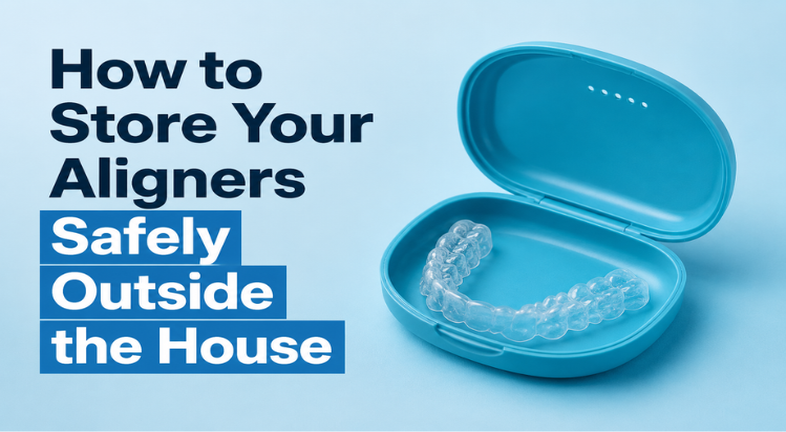 How to Store Your Aligners Safely Outside the House
Taking your clear aligners out while you're away from home is part of everyday life. The important part is knowing where to keep them until it's time to wear them again. Whether you're eating at a restaurant, traveling, running errands, or attending a social event, instead of leaving them on the table or wrapping them in a tissue or napkin, place them in a protective aligner case. Poor storage can lead to lost, damaged, or dirty aligners.
Read More Should You Use Mouthwash to Clean Aligners?
Can you clean aligners with mouthwash? Mouthwash is not the preferred way to clean clear aligners. It is formulated for rinsing your mouth, while aligner-safe cleaning products are designed to clean the trays. Coloured mouthwash can also stain or discolour clear plastic. Remove your aligners before using mouthwash, then clean your trays separately with cool or lukewarm water and an approved cleaning method.
Read More


Heading