.webp)
| Key Differences between Aligners and Retainers |
The confusion between retainers vs aligners is one of the most common questions orthodontic patients ask, and it makes complete sense. Both devices fit over your teeth, both are often made from clear plastic, and both play a role in shaping the outcome of your smile. Yet they serve fundamentally different purposes, and mixing them up can cost you both time and results.
This guide cuts through the confusion directly. Clear aligners are active orthodontic appliances designed to move teeth into new positions, while retainers are passive appliances designed to hold teeth where they already are.
The simplest way to frame retainers vs aligners is to think about the direction of movement. Aligners are engineered to push, tilt, and rotate teeth over weeks and months. Each tray in a series is slightly different from the last, and that subtle difference is what generates force against the tooth surface.
Retainers, on the other hand, are engineered to resist movement. After teeth have been shifted into alignment, they naturally want to drift back toward their original positions. A retainer prevents that from happening.
To understand how clear aligners work , it helps to understand the biology of tooth movement. Teeth sit in sockets surrounded by a membrane called the periodontal ligament. When consistent, controlled pressure is applied to a tooth, that ligament responds by triggering a remodeling process in the surrounding bone. Bone dissolves on the side receiving pressure and rebuilds on the side being vacated. Over time, this process allows teeth to shift into new positions.
Clear aligners are best suited for mild to moderate orthodontic issues, including crowding, spacing, and certain bite problems. Severe skeletal discrepancies often require traditional braces or even surgery, but for the majority of adults and older teens seeking straighter teeth, aligners are a highly effective option. Your orthodontist will use digital imaging to map out your treatment and determine how many trays you need before you begin.
The answer to what do retainers do is both simpler and more critical than many patients expect. After active orthodontic treatment ends, whether with braces or aligners, the bone surrounding your newly positioned teeth is still soft and unstable. It takes months for that bone to fully mineralize and lock your teeth into their corrected positions. During this vulnerable window, teeth are highly susceptible to relapse, drifting back toward wherever they came from. A retainer holds your teeth firmly in place during this consolidation period and, ideally, for life.
.webp)
Retainers come in two broad categories. Removable retainers include the classic Hawley retainer, which uses a wire and acrylic plate, and the increasingly popular clear Essix retainer, which looks nearly identical to an aligner tray. Fixed retainers, also called bonded or permanent retainers, consist of a thin wire cemented to the back surfaces of the front teeth. Fixed retainers offer the advantage of constant protection without requiring patient compliance, while removable options are easier to clean and replace.
Understanding how do retainers work also includes knowing that you need one as soon as your active orthodontic treatment ends. This applies whether you finished braces, clear aligners, or any other appliance. Orthodontists typically prescribe full-time retainer wear for the first few months post-treatment, gradually transitioning to nighttime-only wear. However, many professionals now recommend wearing retainers every night indefinitely, since teeth never fully stop moving throughout life.
When comparing retainers vs aligners side by side, several differences become immediately clear. The most fundamental is purpose: aligners are prescribed to correct misalignment, while retainers are prescribed to prevent misalignment from returning.
Aligners are worn in a progressive sequence, with each tray moving teeth incrementally forward in the treatment plan. Retainers are worn indefinitely at the same fixed position, with no progression intended. Here is a table showing clear differences between the devices.
| Feature | Aligners | Retainers |
| Purpose | Move teeth into a new position | Maintain teeth in their corrected position |
| Main Use | Orthodontic treatment | Post-orthodontic maintenance |
| When Used | During active treatment | After braces or aligner treatment |
| Tooth Movement | Yes, gradual controlled movement | No significant movement intended |
| Material | Clear plastic trays | Clear plastic or wire/acrylic |
| Appearance | Nearly invisible | Usually invisible or minimally visible |
| Wear Time | Typically 20–22 hours/day | Often, nighttime only after the initial phase |
| Treatment Duration | Several months to years | Often, long-term or lifelong maintenance |
| Replacement Frequency | New tray every 1–2 weeks | Replaced only if damaged or worn |
| Removability | Removable | Can be removable or fixed |
The question of whether aligners are better than retainers for straightening teeth is a bit like asking whether a hammer is better than a wrench for driving a nail. They are designed for entirely different tasks, so comparing them directly misses the point. If you have teeth that need to be straightened, aligners are the appropriate tool. Retainers cannot straighten teeth that are misaligned; they can only maintain teeth that have already been corrected.
That said, aligners are widely considered one of the most patient-friendly orthodontic options available today. Their removability makes eating, brushing, and flossing far easier than with traditional braces. Their near-invisibility addresses many adults' concerns about appearance during treatment. And their digital precision allows for highly predictable outcomes when treatment planning is done carefully. For most mild to moderate cases, clear aligners deliver results comparable to traditional braces with greater lifestyle comfort.
Retainers, meanwhile, are unmatched at their specific job. No other appliance maintains orthodontic results as reliably as a well-fitted retainer worn consistently. In that sense, both appliances are excellent at what they do. The question is never which one is better in absolute terms, but which one is appropriate for where you are in your orthodontic journey.
By now, the distinction between retainers vs aligners should be clear enough to guide your next conversation with your orthodontist. If you are looking to correct spacing, crowding, or a bite issue, aligners are the starting point. If you have already completed treatment and want to protect those results, a retainer is not optional but essential. Providers like Caspersmile offer at-home teeth straightening with their custom-fit aligners. To ensure the progress and results of aligners, crystal clear retainers are provided as well.

Curated the best for your knowledge
 Are Ultrasonic Cleaners Worth It for Clear Aligners?
Yes, ultrasonic cleaners for clear aligners can be worth it, especially for removing plaque, debris, and buildup that regular brushing may miss. They use high-frequency sound waves to create tiny bubbles that help loosen buildup from the trays and other orthodontic appliances, including retainers, mouthguards, and night guards. However, they are not essential for everyone and have some limitations. Here’s how ultrasonic cleaners work, their benefits and drawbacks, and how to use one safely.
Read More The Aligner Diet: Can Clear Aligners Really Cause Weight Loss?
Some people notice they've lost a little weight after starting clear aligner treatment. It can happen, especially during the first few weeks, when taking the trays out for every meal and snack takes some getting used to. Sore teeth can also make eating less appealing for a day or two. The amount of weight lost varies from person to person, and not everyone experiences this change. Below, we'll break down why it happens, whether it's actually good for you, and what to know before treating your aligners like a diet plan.
Read More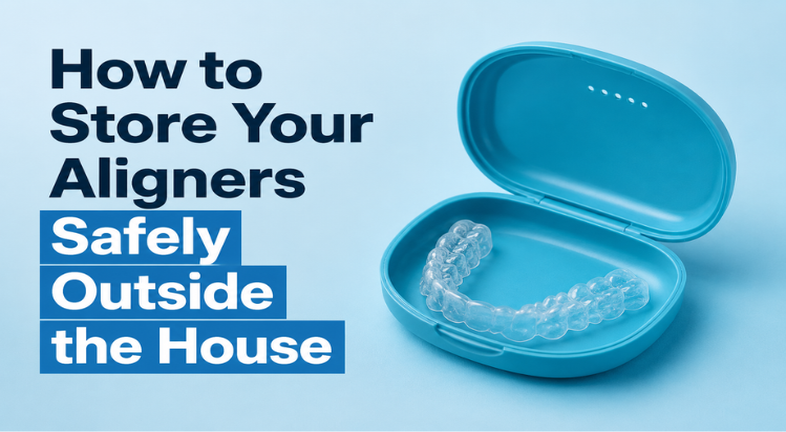 How to Store Your Aligners Safely Outside the House
Taking your clear aligners out while you're away from home is part of everyday life. The important part is knowing where to keep them until it's time to wear them again. Whether you're eating at a restaurant, traveling, running errands, or attending a social event, instead of leaving them on the table or wrapping them in a tissue or napkin, place them in a protective aligner case. Poor storage can lead to lost, damaged, or dirty aligners.
Read More


Heading