.webp)
| Retainers are essential for preventing orthodontic relapse, as teeth naturally shift back toward their original positions after treatment. To maintain a perfect smile, wear retainers full-time for 4–6 months, then at night indefinitely. Types include removable clear/Hawley retainers and fixed lingual wires. |
Key Takeaways for Long-Term Success:
After months or even years of orthodontic treatment, the moment your braces come off, or your final aligner tray snaps into place, feels nothing short of liberating. Your teeth are straight, your smile is exactly what you worked so hard to achieve, and it is natural to assume the hard part is finally behind you.
The truth, however, is that the journey does not end there. Keeping your smile in perfect alignment requires one simple but lifelong commitment: retainers for life to maintain your smile. Many people underestimate just how important retainers are once active treatment is finished.
.webp)
There is a common misconception that retainers are a temporary phase, something to wear for a few months after treatment before you can move on. Why retainers are for life comes down to the basic biology of your mouth. Your teeth are not fixed in bone the way bolts are fixed in metal. They sit in a soft tissue called the periodontal ligament, which acts like a flexible suspension system. This ligament has memory, and it naturally wants to pull your teeth back toward where they came from.
This tendency is called relapse, and it is not a sign that your treatment failed. It is simply how teeth work. Even people who have never had orthodontic treatment experience gradual tooth movement throughout their lives. For people who have had braces or aligners, the pressure to drift back toward the original position is often even stronger. The only thing standing between your perfectly aligned teeth and slow, progressive shifting is consistent lifetime retainer use.
Understanding this reality changes how you think about your retainer. It stops being a nuisance and starts being a protective tool, something you use not because you have to, but because you understand exactly what it is doing for you every single night.
When orthodontic treatment ends, the periodontal ligament fibers surrounding your teeth remain stretched and strained from repositioning. Research consistently shows that the highest risk of relapse occurs in the first year after treatment, which is why most orthodontists recommend full-time retainer wear initially before transitioning to nighttime use. Without proper wearing of retainers for life, the ligament gradually draws teeth back toward their original positions, undoing months or years of careful correction.
The degree of relapse varies from person to person, and it depends on factors like the severity of the original misalignment, the type of treatment used, and how diligently the retainer was worn during the initial phase. Crowding in the lower front teeth, in particular, tends to return relatively quickly without consistent retainer use. Gaps that were closed during treatment can begin to reopen within weeks of stopping retainer wear.
For most adults, the biggest obstacle to wearing retainers for life is not motivation but consistency. Life gets busy, routines change, and the retainer that used to be part of every bedtime ritual gradually gets forgotten in a drawer somewhere. The solution is to treat your retainer the way you treat other nonnegotiable parts of your health routine, such as brushing your teeth or taking prescribed medication.
Anchoring your retainer wear to an existing habit is one of the most effective strategies. Placing it right next to your toothbrush so you see it every night before bed removes the mental step of remembering to grab it. Keeping a retainer case on your nightstand rather than in a cabinet adds a visual cue that reinforces the behavior night after night. Small environmental nudges like these have a surprisingly powerful effect on long-term adherence.
For most people in the maintenance phase of their orthodontic journey, nighttime retainer wear is the standard recommendation. Wearing your retainer every night while you sleep means you are protecting your alignment for roughly seven to nine hours without it affecting your daily life in any way. You wake up, remove it, clean it, and go about your day. That is genuinely all it takes to preserve years of treatment results.
There are different types of retainers, and you must understand each type before choosing the one for yourself.
There are two main categories of retainers, and each has distinct advantages depending on your lifestyle and orthodontic needs. Removable retainers, including both clear plastic retainers and the older Hawley wire-and-acrylic style, offer the flexibility to take them out for eating, drinking anything other than water, and cleaning. This makes oral hygiene easier and means your retainer itself is simpler to keep clean.
Fixed or bonded retainers, sometimes called permanent retainers, are thin wires bonded directly to the backs of your teeth. They provide continuous retention without requiring any action on your part because you literally cannot remove them. The obvious advantage is that compliance is automatic. The limitation is that they require more careful oral hygiene since flossing beneath the wire takes a little extra effort, and they cannot correct any relapse that occurs around them if teeth shift despite the wire.
For most people, a combination approach works well. A bonded retainer on the lower front teeth handles the highest-relapse zone automatically, while a removable clear retainer worn nightly covers the upper arch. This approach balances the convenience of permanent retainer use with the thoroughness of removable coverage.
Clear retainers have become the most popular removable option for a straightforward reason: they are virtually invisible when worn, comfortable against soft tissue, and simple to use. Unlike Hawley retainers with their visible wire across the front teeth, clear retainers fit snugly over your entire arch, distributing retention forces evenly and staying discreet enough that most people will never notice you are wearing one, even in conversation.
High-quality, clear retainers, particularly those made from durable, BPA-free materials and custom-fitted to your exact dental impressions, can last for years with proper care. Investing in a well-made retainer is one of the simplest things you can do to protect a significant investment of time and money in orthodontic treatment.
Every smile that has been straightened through orthodontic treatment represents a genuine investment, and protecting it comes down to one simple act: wearing retainers for life. The people who keep their results for decades are not the most disciplined by nature; they are simply the ones who made retainer wear part of their nightly routine until lifetime retainer use became as automatic as brushing their teeth.
Wherever you are in your orthodontic journey, the message from every professional is the same. Your retainer is not optional, and it never was. Wear it faithfully, replace it when it wears out, and your straight smile will take care of itself. If you are looking for trusted providers, Caspersmile offers clear plastic retainers to help you lock in your smile forever, that too from the comfort of your home.

Curated the best for your knowledge
 Are Ultrasonic Cleaners Worth It for Clear Aligners?
Yes, ultrasonic cleaners for clear aligners can be worth it, especially for removing plaque, debris, and buildup that regular brushing may miss. They use high-frequency sound waves to create tiny bubbles that help loosen buildup from the trays and other orthodontic appliances, including retainers, mouthguards, and night guards. However, they are not essential for everyone and have some limitations. Here’s how ultrasonic cleaners work, their benefits and drawbacks, and how to use one safely.
Read More The Aligner Diet: Can Clear Aligners Really Cause Weight Loss?
Some people notice they've lost a little weight after starting clear aligner treatment. It can happen, especially during the first few weeks, when taking the trays out for every meal and snack takes some getting used to. Sore teeth can also make eating less appealing for a day or two. The amount of weight lost varies from person to person, and not everyone experiences this change. Below, we'll break down why it happens, whether it's actually good for you, and what to know before treating your aligners like a diet plan.
Read More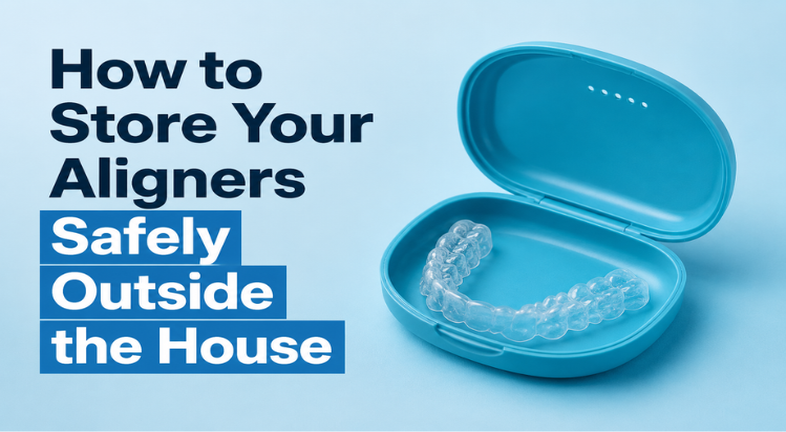 How to Store Your Aligners Safely Outside the House
Taking your clear aligners out while you're away from home is part of everyday life. The important part is knowing where to keep them until it's time to wear them again. Whether you're eating at a restaurant, traveling, running errands, or attending a social event, instead of leaving them on the table or wrapping them in a tissue or napkin, place them in a protective aligner case. Poor storage can lead to lost, damaged, or dirty aligners.
Read More


Heading