.webp)
Yes, you can get clear aligners without a dentist visit through several direct-to-consumer brands. But whether you should is a different question entirely.
The process has become surprisingly accessible, and for mild cases, it can work well. Still, there are real trade-offs worth understanding before you order anything online. Here is what you need to know upfront.
.webp)
The whole concept of at-home teeth straightening kits took off in the mid-2010s when brands realized that the most expensive part of orthodontic treatment was not the aligners themselves. It was the office visits. So they cut those out, mostly, and passed some of that savings to the customer.
The way it usually works is straightforward. You order an impression kit, make molds of your teeth at home, mail them back, and a licensed dentist or orthodontist reviews your case remotely. Then a series of invisible aligners without a dentist doing hands-on work gets shipped to your door. You wear each set for about a week or two, progress through them, and theoretically end up with straighter teeth.
Some companies have gone further, offering in-person scanning at retail locations or partnering with local dental offices for the initial scan. But the defining feature is that most of the treatment happens without you ever sitting in a dental chair.
There is a common misconception that teeth aligners without a dental visit mean zero professional involvement. That is not exactly true with the reputable companies. A licensed provider does review your case, usually from X-rays and impressions. What gets skipped is the in-person exam, the hands-on assessment, and the regular progress check-ins that traditional orthodontic offices provide.
That distinction matters more than people realize. A remote review can catch obvious disqualifying factors, but it cannot always detect bone loss, gum disease in early stages, or bite issues that photographs might miss. It is a trade-off: convenience and cost savings on one side, reduced clinical oversight on the other.
Clear aligners without a dentist visit can work really well for mild to moderate crowding, small gaps, and minor spacing issues. They are often a good fit for people whose teeth are generally healthy and who mainly want cosmetic improvements rather than major bite correction. People who had braces before and experienced slight relapse also tend to do well with at-home aligners.
That said, not all companies follow the same standards. It is worth choosing one that uses X-rays, has licensed orthodontists reviewing cases, and clearly explains what happens if treatment does not go as planned. One option many people explore is Caspersmile, which handles the entire process remotely, from home impressions to aligners delivered directly to your door.
At-home aligners are not designed for severe crowding, major bite problems, or complex tooth movements like significant rotations or vertical shifts. They also cannot treat underlying issues like gum disease or bone problems.
If your case feels more than mild, exploring other ways to straighten your teeth is a smart move before committing to any single approach.
The convenience of at-home aligners is real, but tooth movement is still a medical process, and there are a few risks people rarely hear about before starting treatment.
Any tooth movement carries some degree of risk. Root resorption, where the roots of teeth shorten slightly during orthodontic treatment, can occur with any aligner therapy. With in-office treatment, an orthodontist monitors for this through periodic X-rays. With at-home teeth straightening kits , monitoring is absent or minimal at best.
For most people, the risk is low, and the resorption that does occur is minor. But for people with certain tooth structures or histories, the risk is higher, and without clinical oversight, it can go undetected until it becomes a more serious problem.
Starting any kind of tooth movement when gum disease is present is considered a significant risk by most dental professionals. The issue is that mild gum disease can be invisible to the patient. It might not hurt, it might not bleed noticeably, and photographs or impressions would not reveal it.
This is one of the strongest arguments for at least getting a dental checkup before beginning treatment. Many dentists will do a general health assessment even if you plan to pursue at-home treatment, and knowing your baseline before starting is just good sense.
The honest answer is that it depends entirely on your specific situation. Clear aligners without a dentist visit can be a genuinely good option for the right candidate, meaning someone with mild, cosmetic misalignment, healthy teeth and gums, and the discipline to wear their aligners consistently. For that person, the cost savings are real and the results can be comparable to in-office treatment.
For anyone outside that profile, the calculus shifts. The convenience of invisible aligners without a dentist overseeing your case is worth less when the complexity of your case increases. More complex cases need more clinical judgment, and that judgment is hard to replicate through photos and remote review alone.
What matters most is being honest with yourself about what your teeth actually need, not just what you hope they need. That clarity, more than anything else, is what determines whether at-home treatment is a smart choice or a shortcut that costs more in the end.

Curated the best for your knowledge
 Are Ultrasonic Cleaners Worth It for Clear Aligners?
Yes, ultrasonic cleaners for clear aligners can be worth it, especially for removing plaque, debris, and buildup that regular brushing may miss. They use high-frequency sound waves to create tiny bubbles that help loosen buildup from the trays and other orthodontic appliances, including retainers, mouthguards, and night guards. However, they are not essential for everyone and have some limitations. Here’s how ultrasonic cleaners work, their benefits and drawbacks, and how to use one safely.
Read More The Aligner Diet: Can Clear Aligners Really Cause Weight Loss?
Some people notice they've lost a little weight after starting clear aligner treatment. It can happen, especially during the first few weeks, when taking the trays out for every meal and snack takes some getting used to. Sore teeth can also make eating less appealing for a day or two. The amount of weight lost varies from person to person, and not everyone experiences this change. Below, we'll break down why it happens, whether it's actually good for you, and what to know before treating your aligners like a diet plan.
Read More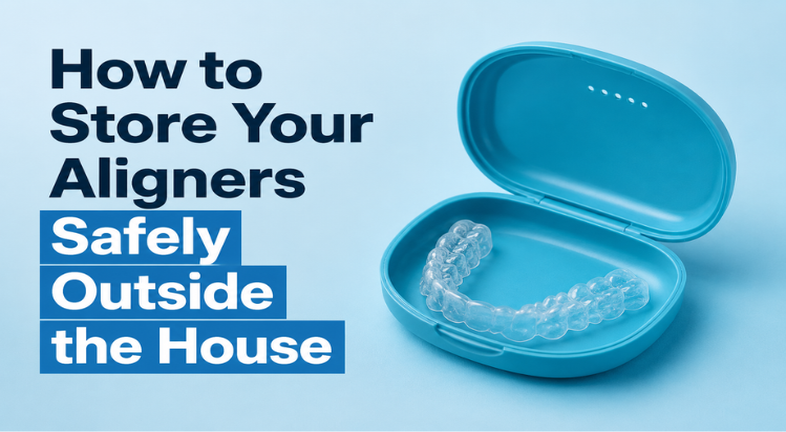 How to Store Your Aligners Safely Outside the House
Taking your clear aligners out while you're away from home is part of everyday life. The important part is knowing where to keep them until it's time to wear them again. Whether you're eating at a restaurant, traveling, running errands, or attending a social event, instead of leaving them on the table or wrapping them in a tissue or napkin, place them in a protective aligner case. Poor storage can lead to lost, damaged, or dirty aligners.
Read More


Heading