



Clear aligners have revolutionized the way we think about straightening our teeth. Quietly and almost under the radar, they are everywhere today. Yet, the same question arises over and over again during consultations and late-night Google searches...Are clear aligners only meant for front teeth, or can they move back teeth, too?
Molars and premolars, or the teeth that do all of the work of chewing (the heavier chewing), don't receive much attention. However, the reality is that these back teeth play an extremely important role in developing a balanced bite and allowing your jaw to function properly. This guide will explain everything clearly and honestly, so you know what to expect from the start
How Teeth Movement Works
Before asking, do clear aligners work on back teeth? It helps to understand how any orthodontic movement happens in the first place. Teeth are not glued into the jaw. They sit in bone, held by ligaments that respond to pressure. When a steady force is applied, the bone on one side breaks down while new bone forms on the other. That process is slow. It’s biological. It cannot be rushed without consequences.
How Do Aligners Work at a Biological Level?
This is where many people get confused. A teeth aligner does not push teeth violently into position. Instead, it applies light, consistent pressure over time. Each tray is slightly different from the previous one. That difference might be tiny, fractions of a millimeter, but the body responds to it.
Clear aligners wrap around the entire dental arch. Not just the front teeth. That means molars and premolars are included in the force system. In theory, yes, aligners can move back teeth. In practice, success depends on several moving parts coming together at the right time.
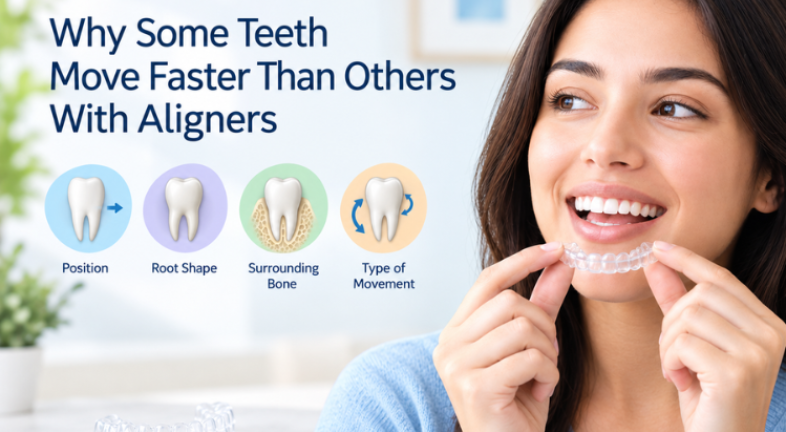
Bone density matters. Root shape matters. The direction of movement matters too. Rotating a back tooth is different from tipping it. Translating it bodily through bone is harder still. Sometimes, aligners handle this well. Sometimes they struggle.
Why Back Teeth Are Different
Molars have multiple roots. They sit in denser bone. They also absorb chewing forces every day. That makes them more resistant to movement compared to front teeth. Not impossible. Just more demanding. This is why orthodontic planning becomes crucial when asking how clear aligners work for posterior teeth.
When Clear Aligners Can Move Back Teeth
This is where expectations should be grounded. Clear aligners shine in certain cases. They stumble in others.
Mild to Moderate Alignment Issues
Clear aligners work best when the movements required are controlled and predictable. Small spacing issues. Mild crowding. Slight rotations. Minor arch expansion. In these cases, back teeth often move successfully along with the rest of the arch.
A tooth aligner can gently guide molars into better positions when the distance isn’t extreme. Think nudging, not dragging. When someone asks do aligners work for back teeth, this is usually the scenario where the answer is yes.
Healthy Roots and Supportive Bone
Teeth need something solid to move through. If the bone is healthy and the roots are strong, aligners have a much better chance of success. Past dental trauma, gum disease, or root shortening can limit what’s possible.
Clear aligners rely on biology cooperating. If the foundation isn’t stable, no aligner brand can override that reality.
Compliance Changes Everything
This part gets underestimated. Aligners only work when worn. Twenty to twenty-two hours per day is not a suggestion. It’s the rule.
Back teeth are especially unforgiving when compliance slips. Missed wear time means missed force. And missed force leads to stalled movement. Or partial movement. Or relapse.
Attachments, those small tooth-colored bumps, often help aligners grip back teeth better. Elastics may be added too. None of this works if trays sit in a case more than in the mouth.
Planning, Scans, and Monitoring
Clear aligners are only as good as the plan behind them. Accurate digital scans matter. So does staging the movement correctly. Back teeth often require slower sequencing.
Regular monitoring allows refinements. Sometimes trays need adjustment. Sometimes, more aligners are added. That’s normal. That’s part of making sure how do aligners work translates into real results, not just simulations.
Limitations & When Aligners Might Struggle With Back Teeth
Now for the uncomfortable truth. Clear aligners are powerful, but they are not magic.
Complex or Heavy Corrections
Large movements demand more control. Significant molar rotation. Vertical changes. Major bite correction. These can stretch aligner capabilities.
Back teeth don’t always respond well to plastic alone. In those cases, traditional braces or hybrid treatments often deliver better outcomes.
Root and Bone Constraints
Dense bone slows movement. Short roots limit safe force levels. Prior crowns or large fillings can interfere with the aligner grip. All of this affects whether tooth aligners can do the job safely.
Ignoring these factors increases risk. Root resorption. Gum problems. Unstable results.
Compliance Issues Revisited
Yes, it comes up again. Because it matters that much.
Inconsistent wear means inconsistent force. Back teeth will often be the first to stop responding. Patients sometimes think the front looks fine and assume everything else follows. That assumption causes problems later.
Space Limitations
Crowding needs space. Without room, teeth have nowhere to go. Aligners cannot create space out of nothing. Sometimes, enamel reduction is used. Sometimes expansion helps. Sometimes extractions are required.
If there’s no space, aligners alone may not move back teeth effectively.
Severe Bite or Skeletal Problems
When the issue is jaw-based rather than tooth-based, aligners are limited. Deep bites. Open bites are tied to jaw position. Skeletal crossbites.
In these cases, aligners might improve alignment but not function. And function matters.
What Research & Orthodontic Experts Say
Orthodontists are fairly aligned on this. Clear aligners are effective for many types of movement, including back teeth, when cases are chosen carefully.
Case-by-Case Reality
There is no universal yes or no. Anyone promising guaranteed molar movement without evaluation is overselling. Professional diagnosis determines feasibility. Experts emphasize that how clear aligners work depends less on the brand and more on planning, compliance, and biological response.
Retention Is Not Optional
Moving back teeth is only half the story. Keeping them there is the real challenge. It is absolutely necessary to avoid teeth relapse after clear aligner treatment . Teeth have a tendency to fall back to their pre-treatment position. Thus, if you don’t keep them in the postions, all of the effort and investment goes down the drain.
However, this brings us to a common question. Can a retainer move teeth back? Or can retainers move teeth back unintentionally?
Technically, they can’t. They aren’t designed to move teeth. Rather to hold them where they are. However, if somehow your retainer is deformed and you force it on your teeth, then it can move them, and in all the wrong directions. So, pls beware of that. If a retainer is deformed, replace it immediately.
What to Expect: Treatment Timeline, Challenges & Tips for Success
While every case is different, most people follow a similar timeline and face a few common challenges during treatment.
Treatment Time: How Long it Can Take
Back teeth often take as long, sometimes longer, than front teeth to move. Typical treatment ranges from 12 to 24 months, depending on complexity and compliance. Aligners may appear simple, but posterior movement requires patience.
Expect Refinements
Refinements are not failures. They’re adjustments. Back teeth often need additional trays to fine-tune positioning. That’s common. It’s part of responsible orthodontics.
Hygiene Matters More Than Ever
Molars are cavity-prone. Add aligners into the mix, and hygiene becomes critical. Brush. Floss. Clean trays. Every day.
Neglecting this invites decay and gum inflammation, which can halt movement entirely.
Attachments and Elastics Help
They aren’t aesthetic favorites, but they’re effective. Attachments improve the aligner grip on back teeth. Elastics help coordinate bite forces. Use them if recommended.
Skipping them slows progress. Sometimes dramatically.
Best Clear Aligner Brands That Can Address Back Teeth
Not all aligner systems are equal. Planning depth, material quality, and clinical oversight vary.
Not all clear aligner systems are marketed or structured in the same way. Some focus on overall alignment through a remote or hybrid model, while others operate strictly under in-clinic supervision. When back teeth are part of the alignment plan, it’s important to understand what each brand officially offers and how treatment is delivered.
Caspersmile
Caspersmile provides custom clear aligners created using 3D scans or impressions, followed by a treatment plan that is reviewed by dental professionals. The aligners are designed to straighten teeth gradually through a series of trays worn over time.
Caspersmile offers options for both single-arch and dual-arch treatment, as well as daytime and nighttime aligner plans , depending on patient needs. The brand positions its aligners as a solution for overall teeth straightening rather than cosmetic touch-ups alone.
Their process includes treatment planning, aligner delivery, and guidance throughout the treatment journey. Caspersmile also notes that refinements may be part of treatment where clinically appropriate, which aligns with standard aligner-based orthodontic approaches.
Caspersmile aligners are intended to address alignment across the dental arch when prescribed within suitable cases.
Invisalign
Invisalign is a clinician-directed clear aligner system that uses digital treatment planning software known as ClinCheck. According to Invisalign’s official materials, this software allows dentists and orthodontists to plan tooth movement in stages before treatment begins.
Invisalign aligners are made from SmartTrack material, which the company states is designed to deliver controlled and consistent force during treatment. Invisalign also explains that attachments may be bonded to teeth in certain cases to help guide specific movements, and elastics may be used when needed to support bite alignment.
Treatment is carried out under professional supervision, with regular monitoring by a licensed dental provider. Invisalign states that suitability and outcomes vary by individual case, and that treatment plans are customized based on clinical assessment. The brand presents its system as capable of addressing a wide range of orthodontic concerns, depending on professional diagnosis and treatment planning.
Smile White
Smile White offers clear aligner treatment through a dentist-supervised model. Patients receive 3D scans and a personalized treatment plan created and monitored by dental professionals.
Smile White indicates that its aligners are designed to address various orthodontic concerns, including crowding, spacing, and bite-related alignment issues, where clinically appropriate. The brand also highlights ongoing professional monitoring throughout treatment, rather than a purely self-directed model.
Smile White recommends wearing aligners for 20–22 hours per day, which aligns with standard clear aligner protocols. Retainers are also part of the post-treatment process, emphasizing the importance of maintaining results after active alignment ends.
Important Note on Brand Suitability
None of these brands claims that clear aligners are appropriate for every orthodontic case or that back teeth movement is guaranteed. All emphasize the importance of case suitability, professional assessment, and patient compliance in determining outcomes.
Clear aligners may be effective for full-arch alignment, including back teeth, when prescribed and monitored appropriately and when biological and structural conditions allow for safe movement.
Clear Aligners Can Work on Back Teeth
It is not only the front teeth that can be easily moved with clear aligners; the back teeth may also be moved by these very same appliances. The key is suitability. The degree of movement achieved, however, will again depend on the diagnosis, treatment plan, biological and active growth potential of each individual, and level of compliance with treatment protocol.
Mild to moderate cases are typically able to see positive results with the use of clear aligners; However, complex cases may require additional orthodontic measures or methods to obtain the desired results.
The best outcomes come from personalized treatment plans, professional oversight, and consistent aftercare. That’s how back teeth move. And stay put.





Heading